“I don't know how to code.”
Every path you find seems to start with months of learning syntax before you can build anything real.
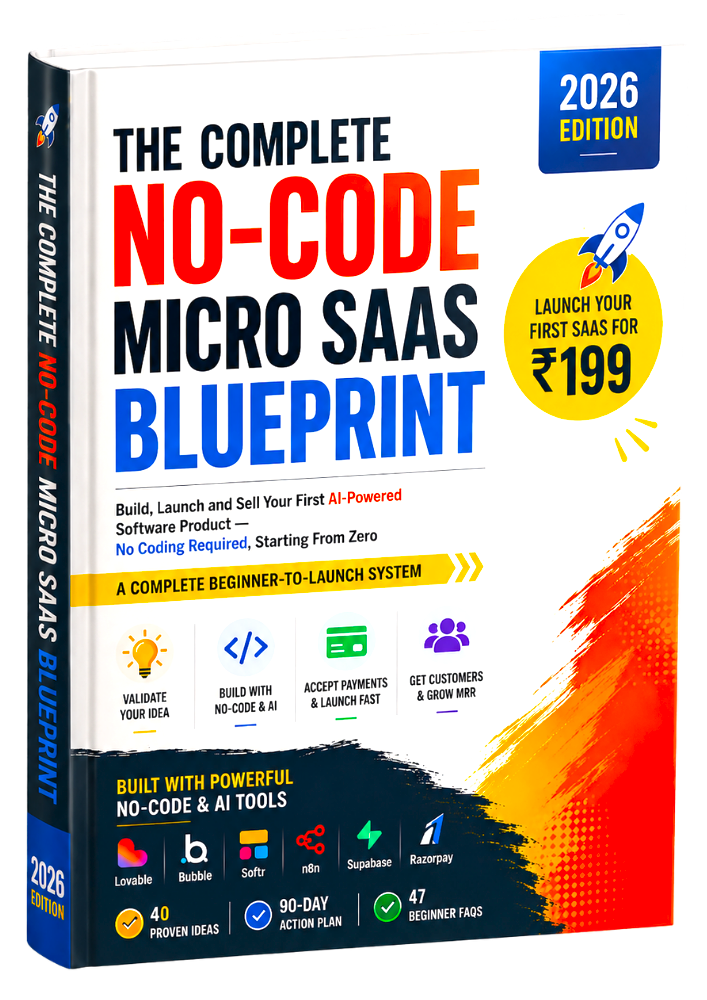
From idea validation to your first launch — a practical blueprint for building and selling your first software product with AI and no-code tools.
One-time payment • Digital product
The starting point
If any of these sound familiar, you are not stuck because you lack ability. You are stuck because nobody has given you the order of operations.
“I don't know how to code.”
Every path you find seems to start with months of learning syntax before you can build anything real.
“Developers are too expensive.”
A custom build used to mean ₹2–10 lakh in developer costs — money you'd spend before knowing if the idea works.
“I don't know if people will actually pay.”
The idea makes sense in your head, but nothing has confirmed that anyone will hand over money for it.
“I don't know which AI/no-code tools to use.”
Lovable, Bubble, Softr, n8n, Supabase, Razorpay — plenty of names, no clear map of which job each one does.
“I don't know how to get my first customers.”
Even a finished product is useless if you have no repeatable way to reach the first ten people who'll pay.
“I keep researching instead of building.”
Another video, another thread, another tool comparison — and the product still doesn't exist.
What changed
AI-powered no-code builders let you describe what you want in plain English and get back a working application with a database, user accounts and payments already wired in. You are not learning to code — you are learning to direct a very capable builder.
Lovable
Prompt-to-app builder for your product interface
Bubble
Visual builder for more complex app logic
Softr
Fast client portals and dashboards on existing data
n8n
Visual automations — reminders, alerts, workflows
Supabase
Database and user accounts, free tier to start
Razorpay
Accept subscription payments from Indian customers
The path this book walks you through
What's inside
Six parts, fifteen chapters and six appendices — organised in the order you'll actually need them.
A five-step framework to find real recurring pain, measure what it costs and confirm demand before you open a single tool.
Forty beginner-buildable product ideas across eight categories, each with the customer, the problem and a starting price range.
Lovable, Bubble, Softr, n8n, Supabase and Razorpay explained by job — which tool to use for which part of your product.
One real idea taken from MVP scope to launch day, with the exact prompts, screens, automations and payment setup.
A cost-based pricing method: price against what the problem costs your customer monthly, then adjust on real conversion data.
Channels that work without an existing audience — your network, niche communities and structured direct outreach.
Day-by-day blocks from research to stabilising your numbers, built around roughly 1–2 hours a day.
Copy-paste prompts for Lovable and Bubble so you never stare at an empty prompt box wondering what to type.
Fill-in worksheets for idea validation, MVP scoping and launch preparation you can use before touching a tool.
Common technical issues beginners hit with no-code builders, automations and payments — and how to fix each one.
Straight answers to the questions that stall beginners: money needed, timelines, registration, competition, wrong ideas.
A month of content prompts to promote your Micro SaaS, plus customer support response templates for day one.
Chapter 4
Explore 40 Micro SaaS ideas you can evaluate, validate and potentially turn into your first product.
Micro SaaS ideas
Grouped into eight categories, each with the customer it serves and the problem it removes. Starting points to run through the validation framework — not a restriction.
Local Business Automation
Booking, reminders and follow-up tools for shops, salons and clinics
Niche Vertical CRMs
Simple CRMs for wedding planners, agents and independent professionals
Content & Creator Tools
Workflow tools for creators, coaches and content teams
Real Estate & Property
Rental management and property workflow tools for small operators
Education & Coaching
Student progress, batch and training management tools
E-commerce & D2C
Order, returns and customer workflow tools for small brands
AI & Automation Add-Ons
AI query bots and automation layers on top of existing tools
Wellness & Personal Services
Class packages, memberships and session tracking tools
Chapter 2 — the engine of the book
The correct order is: find the pain, confirm people will pay to fix it, and only then build.
Go find a complaint people were already making before you showed up — in Reddit threads, profession-specific Facebook and WhatsApp groups, and the 2-star reviews of existing tools. The signal: the same specific complaint from at least 10 different people.
A real problem can be measured. “This is annoying” is weak. “I lose about ₹15,000 a month in no-show appointments” is strong — it tells you the problem is real and roughly what a fix is worth.
Existing competitors prove demand. The goal is not to find something nobody has built — it's to serve a narrower niche better than the current options do.
Direct conversations with people in the niche, using the book's scripts. This step cannot be skipped — only made easier with practice.
Get commitment before code exists. Building without validation is the single most common reason beginner Micro SaaS attempts fail.
Chapter 5
Part 3 is a single, complete, start-to-finish walkthrough of building one real product — the exact prompts, the exact screens, the exact steps. Not theory you have to translate yourself.
Today
Clients
Revenue
PROMPT
Describe the product in plain English and get a working first version back.
INTERFACE
Refine screen by screen with follow-up prompts until the flow feels right.
DATABASE
Store customers, bookings and records — free tiers are enough to start.
AUTOMATION
Connect WhatsApp reminders with a handful of visual n8n nodes.
PAYMENT
Set up Razorpay so Indian customers can subscribe in minutes.
TESTING
Run the pre-launch checklist and three independent test users through the full flow.
LAUNCH
Soft launch to the pre-validated list you built during validation.
Part 4 — Sell & Run It
Most beginner guides stop at the build. This one keeps going — into pricing, customers, support, retention and the numbers you run the business on.
PRICING
A cost-based method: price at roughly 10–30% of what the problem costs your customer each month.
MONETIZATION
Simple tiering that stays manageable — ideally two to three tiers for a first version.
FIRST 10 CUSTOMERS
Three channels that work without an existing audience: network, niche communities and direct outreach.
CUSTOMER SUPPORT
Response templates and a simple FAQ layer so support doesn't consume your week.
RETENTION
Why cancellation happens and what makes a tool embedded in someone's weekly workflow.
METRICS
The handful of numbers that actually matter early — and the leading indicators to track before revenue.
LAUNCH
Launch-day sequence, from pre-launch checklist to a soft launch on your pre-validated list.
Chapter 12
The plan assumes roughly 1–2 hours a day. It is a sequence of work, not a promise of outcome — results depend entirely on your own execution.
PHASE 1
Days 1–14
PHASE 2
Days 15–35
PHASE 3
Days 36–90
The blueprint gives you the sequence. What it produces depends on the work you put in.
Inside the book
Representative sections from the actual blueprint — the contents, the validation framework, the toolkit, the build-along, pricing, the action plan, the FAQ and the prompt library.
Table of Contents
The Micro SaaS Blueprint · DigiStore24
Chapter 2 — Validation Framework
The Micro SaaS Blueprint · DigiStore24
Chapter 3 — Toolkit
The Micro SaaS Blueprint · DigiStore24
Chapter 5 — Build-Along
The Micro SaaS Blueprint · DigiStore24
Chapter 6 — Pricing
The Micro SaaS Blueprint · DigiStore24
Chapter 12 — 90-Day Plan
The Micro SaaS Blueprint · DigiStore24
FAQ — 47 Questions
The Micro SaaS Blueprint · DigiStore24
Appendix A — Prompt Library
The Micro SaaS Blueprint · DigiStore24
Who it's for
Being straight with you
You are looking for guaranteed income
A Micro SaaS is a real business. Nothing here guarantees revenue, customers or an outcome.
You want a magic get-rich-quick system
The book itself says it will not promise a six-figure exit or a machine that runs itself from day one.
You are unwilling to talk to potential customers
Validation depends on direct conversations. That step cannot be skipped — only made easier with practice.
You expect a business to run without effort
The first 90 days need ongoing attention, roughly 1–2 hours a day.
You want someone else to build the business for you
This is a manual you work through with your laptop open, not a done-for-you service.
From the book's 47 FAQs
These answers are taken directly from the blueprint's FAQ section.
Yes. Tools like Lovable are specifically designed for people with no coding background — you describe what you want in plain English. Your job is product thinking and customer conversations, both of which you can do without any technical training.
Most beginner Micro SaaS products can reach a working first version for under ₹15,000 in total tool costs, and often much less if you use free tiers during the building and testing phase.
For a focused MVP following Chapter 5's approach, typically 2–4 weeks of part-time effort, though this varies with the complexity of your specific idea.
That's usually a good sign, not a bad one — it proves demand exists. Focus on serving a narrower niche better than the existing options, rather than searching for something entirely unique.
Treat that as useful data, not failure. It usually means either the niche or the specific pain point needs adjusting — go back to Chapter 2 and try a different angle or a different community.
After — or at least after getting strong pre-commitment (Chapter 2, Step 5). Building without validation is the single most common reason beginner Micro SaaS attempts fail.
Yes — many successful Micro SaaS founders start exactly this way. Chapter 12's 90-day plan assumes roughly 1–2 hours a day, which is realistic alongside other commitments.
No — most founders start as a simple sole proprietorship (Chapter 10) and formalize further as revenue grows.
For most beginner ideas in Chapter 4, no-code tools are more than capable. If you hit a genuine limitation, it's often solvable by simplifying the feature rather than needing custom code — keep your MVP scope tight and this rarely becomes a blocker.
This is exactly why Chapter 2's validation process exists — it's designed to catch a weak idea before you invest weeks building it. If you do pick wrong despite validating, the process itself (not the specific idea) is what you keep and reapply.
No — AI builders like Lovable generate clean, professional designs by default, and you can refine the look with follow-up prompts describing the style you want.
Start with Chapter 6's cost-based framework: price at roughly 10–30% of what the problem costs your customer monthly, and adjust based on real conversion data once you have paying customers.
All 47 questions and answers are included in the blueprint.
The offer
2026 EDITION
One-time payment
Secure payment • Digital product • Access after successful payment
Why ₹199
Scattered information
Structured blueprint
It starts with a problem worth solving, a validated idea, and a system for turning it into something real.
₹199
One-time payment • Digital product